OpenETR Axioms
The ten axioms are the centre of gravity of this page. They describe what OpenETR treats as evidence, how Consequential State is derived, and where the protocol's responsibility ends. The Canonical Definitions provide the precise vocabulary needed to express those axioms, while the Five Maxims distill what follows from them into statements that are easier to remember and apply.
Read the definitions first as a common vocabulary, the axioms as the foundational model, and the maxims as its practical summary. The axioms are a conceptual guide; the wire-format specification and implementation specifications define the normative technical details.
Canonical Definitions
The core definitions are repeated here for convenience:
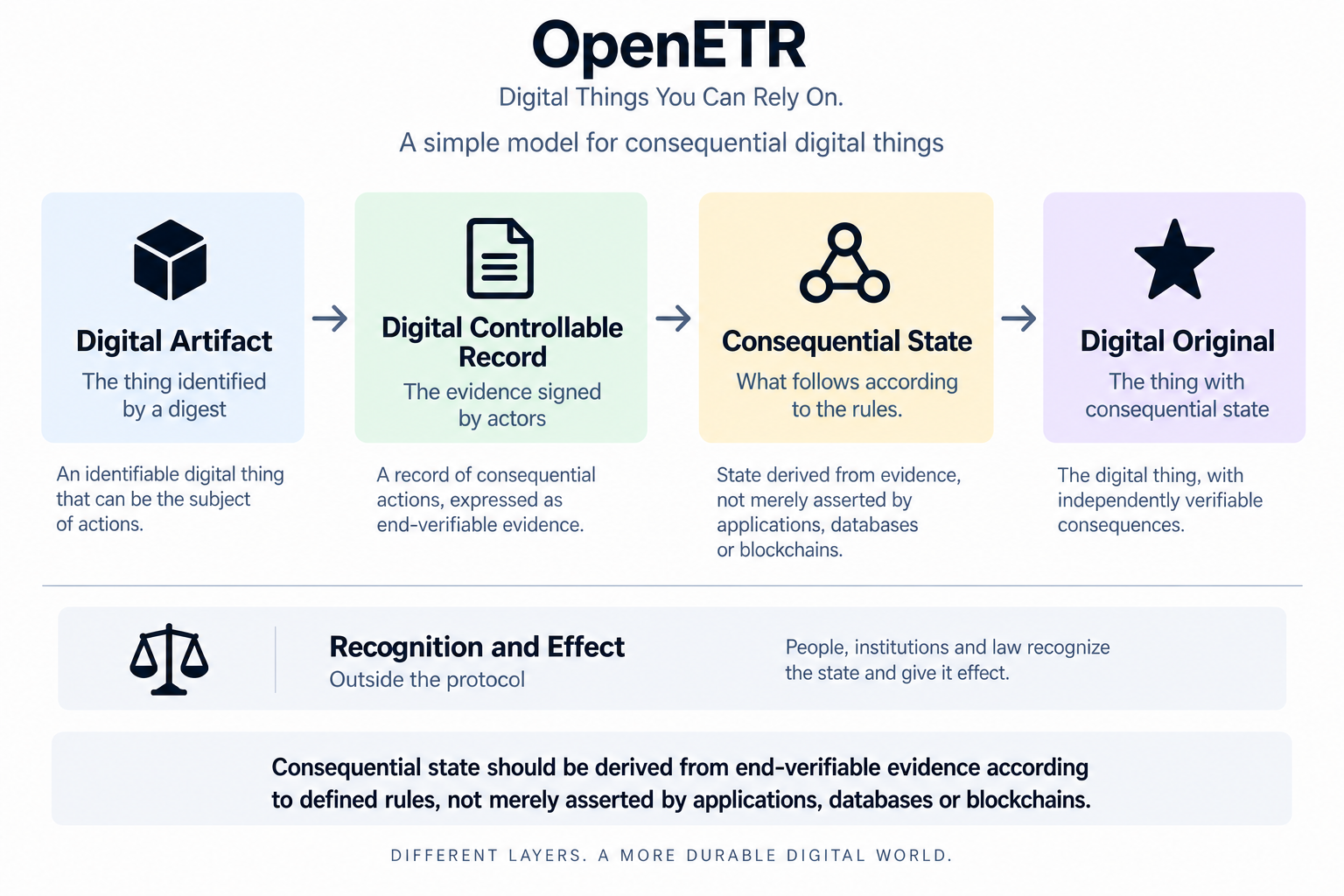
- A Digital Artifact is persistent digital content with a unique content identity, normally established by a cryptographic digest.
- A Digital Controllable Record (DCR) is the signed evidence structure from which defined rules derive Consequential State concerning a Digital Artifact after the evidence is validated.
- Consequential State is state that follows when validated DCR evidence is evaluated according to defined protocol and verifier rules. It is a derived result, not another event or authoritative database row.
- A Digital Original is a Digital Artifact with Consequential State.
- A Key-Based Identifier (KBI) is an identifier whose canonical value is public-key verification material or a deterministic encoding of that material. It identifies the signing key used to verify attributable signed evidence; it does not, by itself, establish the identity, actor type, authority, role, or recognition of the actor associated with that key.
The complete set of formal terms is maintained in Clause 3 of the OpenETR committee draft.
Ten Axioms
The diagram summarizes how the core terms relate before the axioms state the model's foundational propositions.
1. The Digest Identifies The Artifact
A Digital Artifact is identified by a cryptographic digest, independently of its filename, location, format, or number of copies.
2. A Signature Attributes A Statement
Every OpenETR event is an immutable, attributable statement by a signing key. A valid signature establishes authorship and integrity; it does not, by itself, establish authority, recognition, or legal effect.
3. An Anchor Begins A Candidate Record
An Anchor Event establishes the starting point of a candidate Digital Controllable Record (DCR). It does not, by itself, establish uniqueness, validity, or recognition.
4. Links Construct The Evidence Graph
DCR records reference prior records and related evidence through cryptographic identifiers. These links construct an Evidence Graph from which protocol rules can derive Consequential State. The portion concerned specifically with control transitions forms the Control Graph. Links establish relationships; they do not, by themselves, establish validity or state.
5. Events Are Evidence; State Is Derived
Events are not overwritten to represent current state. Consequential State is derived by evaluating signed DCR evidence according to defined rules.
6. Invalid Claims Remain Visible
Conflicting, unauthorized, or malformed statements remain part of the available evidence. A verifier warns about or excludes them according to its rule book rather than erasing signed history.
7. A Digital Original Has Consequential State
A Digital Original is a Digital Artifact for which consequential state has been established through a DCR. Identical copies represent the same artifact; copying its bytes does not independently create another consequential history.
Whether a person, institution, system, or law recognizes that state as authoritative for a particular purpose remains a separate question.
8. Verification Is Separate From Recognition
OpenETR verifies digests, signatures, event links, graph structure, and protocol transitions. External systems, policies, institutions, and laws determine recognition and effect.
9. Identity Is Actor-Neutral And Contextual
A Key-Based Identifier (KBI) identifies public-key verification material used to attribute signed evidence. It does not identify an actor as a matter of protocol. Whether a KBI is associated with a person, organization, service, device, or autonomous agent, and whether that actor is recognized or authorized for a particular purpose, is determined by the applicable context.
In the Nostr binding, the 32-byte public key is the KBI. Its hexadecimal form
is the canonical wire encoding, while npub is the human-readable encoding of
the same key.
10. DCR Evidence Is Portable Across Systems And Domains
Signed records do not belong to one application, relay, operator, or jurisdiction. Domain adapters translate business actions into the general OpenETR model, while any conforming system can store, retrieve, and verify the resulting DCR.
Five Maxims
The same model can be expressed in five short statements:
- Digests identify. A cryptographic digest establishes which exact Digital Artifact the evidence concerns, independently of its filename, location, or number of identical copies.
- Signatures attribute. A valid signature establishes that a particular signing key made a statement concerning the artifact, without by itself proving the signer's identity, authority, or recognition.
- Links order. Cryptographic references connect signed records into an Evidence Graph and establish their claimed relationships, without by themselves deciding whether those records are valid or effective.
- Rules determine what follows. Defined protocol and verifier rules evaluate the available DCR evidence and derive the Consequential State that the evidence supports.
- Recognition gives effect. A relying party, institution, agreement, or law determines whether to accept the evidence or derived state for a stated purpose and what consequence that acceptance produces.
The first three maxims describe portable cryptographic evidence. The fourth describes the derivation of Consequential State. The fifth preserves the boundary between what OpenETR can verify and the effect that others choose or are required to give the result.