From Digital Artifact To Digital Original
The Idea In Plain Language
A digital file can be copied perfectly. That is usually helpful, but it creates a problem when the file matters.
Imagine a warehouse receipt, birth certificate, inspection report, photograph, permit, or bill of lading. A copy may display the same information as the file first issued, but the bytes alone cannot answer:
- Who made a consequential statement about it?
- What has happened to it since then?
- Who, if anyone, can presently act through it?
- Has it been transferred, pledged, revoked, replaced, redeemed, or terminated?
- Which evidence supports the answer?
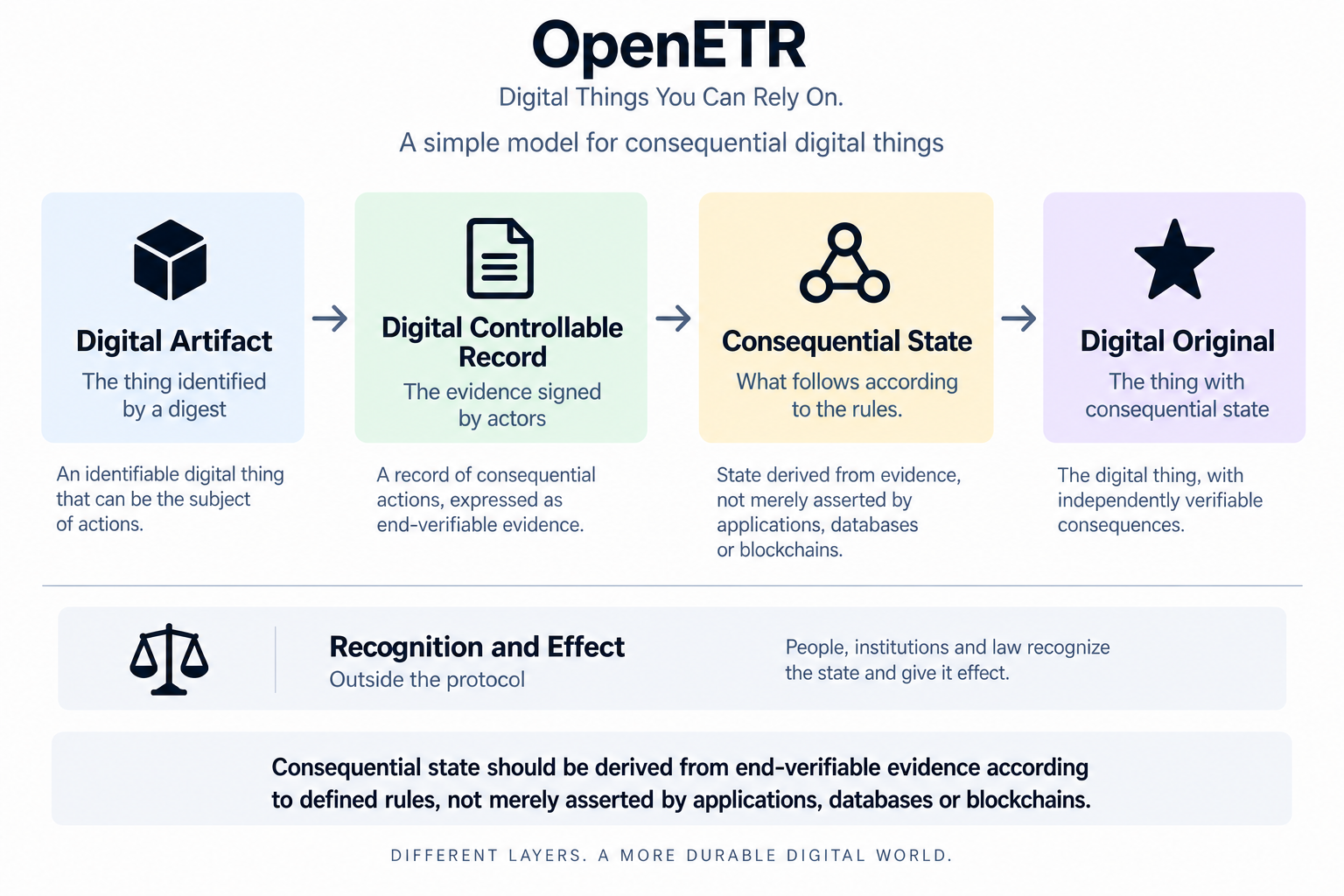
OpenETR separates this problem into three primitives—the Digital Artifact, the Digital Controllable Record, and the Digital Original—connected by one core concept: Consequential State.
1. The Digital Artifact
The Digital Artifact is persistent digital content with a unique content identity, normally established by a cryptographic digest.
It might be a PDF, image, structured data file, media file, or canonical bundle of data. OpenETR calculates a cryptographic fingerprint, called a digest, from the exact bytes. If even one byte changes, the fingerprint changes.
The digest answers a limited but important question:
Which exact digital content are we talking about?
It does not say who issued the artifact, who controls it, whether it is current, or whether anyone should trust it. It only gives the content a stable identity.
Several people can hold identical copies with the same digest. They are copies of the same Digital Artifact, not separate originals.
2. The Digital Controllable Record
The Digital Controllable Record (DCR) is a single end-verifiable record or a graph of related end-verifiable records containing evidence of consequential actions concerning the Digital Artifact.
A DCR may be one end-verifiable signed record or a graph of related signed records. It normally begins with an Anchor Event, which makes the first signed OpenETR statement about the artifact. Under Core Record Ruleset 1.0, later Publisher Notices may express caution, withdrawal, correction, supersession, or another publisher position. Extension rulesets may describe transfer, attestation, encumbrance, discharge, redemption, or termination.
The DCR is not the PDF or image. It is the portable record of consequential statements made about that content.
Each record identifies its signer and links to the relevant artifact and prior records. A verifier can therefore inspect the evidence without relying solely on the application or database that originally displayed it.
The word controllable does not mean that every DCR is legally transferable or that OpenETR controls the underlying person, goods, or rights. It means that the record has a defined protocol lifecycle whose state can be established and changed through valid signed records.
A DCR is an OpenETR protocol construct. It may satisfy requirements for recognition as a Controllable Electronic Record, Electronic Transferable Record, Electronic Trade Document, or another legally recognized record only where the applicable legal requirements are met.
Consequential State Is What Follows
Consequential State is state that follows from consequential actions according to an identified, versioned ruleset. It is not a fourth record-like construct and it is not another name for validation.
Cryptographic and structural validation establishes whether the evidence is authentic, intact, authorized, correctly linked, and otherwise acceptable under the protocol. State transition rules then determine what follows. Depending on the domain, Consequential State might indicate:
- the candidate current controller;
- whether the artifact has been issued or activated;
- whether it is encumbered or discharged;
- whether it has been revoked, redeemed, replaced, or terminated; or
- which competing branches or unresolved warnings exist.
Consequential State is not merely a status field stored in one application's database. Another conforming verifier should be able to obtain the artifact and DCR, apply the same rules, and independently derive the same result.
Cryptography validates the evidence. An identified ruleset determines what follows.
Actions have consequences. OpenETR represents consequential actions as end-verifiable events and defines the rules by which those events change consequential state.
This result is the bridge to the world outside the protocol. A registry, authority, institution, court, counterparty, or other relying party can decide to recognize the consequential state and give it legal, institutional, commercial, or operational effect. Recognition does not create another DCR record. It accepts consequential state for a particular purpose and determines what follows from accepting it.
3. The Digital Original
A Digital Original is a Digital Artifact for which consequential state has been established through a Digital Controllable Record.
This does not make one physical copy of the bytes special. Every exact copy can be checked against the same digest, DCR, and consequential state. Originality therefore belongs to the artifact-and-state relationship, not to a particular device, download, folder, or database row.
In short:
Digital Artifact
  the exact content identified by its fingerprint

Digital Controllable Record
  the signed evidence record or graph spanning the artifact's lifecycle

Consequential State
  what follows according to the rules

Digital Original
  the Digital Artifact with consequential state
Or as one continuous pipeline:
content -> Digital Artifact -> Digital Controllable Record

DCR evidence -> validation -> state transition rules -> consequential state
consequential state -> recognition and effect
artifact + established consequential state -> Digital Original
A Simple Example
Suppose a warehouse issues a PDF receipt for stored grain.
- The PDF's digest identifies the exact Digital Artifact.
- The warehouse signs an Anchor Event concerning that artifact.
- Core Record Ruleset 1.0 derives anchored state for the artifact.
- A later Publisher Notice could express a caution, correction, withdrawal, or supersession position.
- If a transfer ruleset applies, a later signed record may transfer control to a buyer.
- Those linked signed records form the receipt's candidate DCR and span its evidenced lifecycle.
- The evidence is validated and the selected OpenETR ruleset derives the candidate current-controller state.
- The receipt is a Digital Original in the OpenETR sense once Consequential State has been established through its DCR.
- A bank, registry, court, or trading partner decides whether to recognize the signer, state, and transaction under its own rules.
Emailing another copy of the PDF does not create another receipt or transfer control. Changing the PDF creates a different artifact with a different digest. Changing its consequential state requires valid signed evidence, not merely an edited screen or database field.
What OpenETR Does Not Claim
OpenETR can validate signed evidence, apply an identified ruleset, and expose the resulting consequential state. It does not automatically determine:
- the real-world identity of a signer;
- whether the signer had legal authority;
- whether the underlying statement is factually true;
- whether a law, registry, institution, or counterparty must accept the result; or
- what legal or commercial effect follows.
Those are questions of recognition. Identity systems, credentials, registries, contracts, institutional policies, domain rules, and law provide that surrounding context.
Keeping recognition separate is deliberate. It allows different communities and institutions to evaluate the same portable evidence under their own rulebooks without changing the underlying artifact or DCR.
Significance Of The Model
The model restores something that paper often provided implicitly: a practical distinction between the information on a document and the consequential record that people and institutions act upon.
It does so without pretending that digital files cannot be copied and without making one permanent platform the exclusive authority for state.
The three primitives and the core concept therefore have distinct jobs:
| Term | Plain-language purpose |
|---|---|
| Digital Artifact | Identifies the exact content. |
| Digital Controllable Record | Preserves the signed evidence concerning it. |
| Consequential State | Describes what follows when validated evidence is evaluated according to an identified ruleset. |
| Digital Original | Describes the artifact once consequential state has been established through its DCR. |
That separation is the core of the OpenETR model.
Read Next
- Digital Originality develops the model in greater depth.
- Why Control Is Not Recognition explains the external recognition boundary.
- OpenETR Core Record Ruleset 1.0 defines the minimum anchor-and-notice ruleset.
- Provenance Is Not Control distinguishes content history from consequential state.
- Digital Controllable Record Design Note defines the technical construct.