Digital Originality
The Problem
Digital systems make copying effortless. A scanned licence, a PDF certificate, a warehouse receipt, or a digital form can be duplicated perfectly. The bytes therefore cannot tell us which copy has continuing operational significance.
Hashing, signing, timestamping, or storing a file can identify it and provide valuable evidence. None of those acts, by itself, explains what may validly happen next.
The key distinction is:
Digital originality is about consequential state, not copy prevention.
In plain language, the important question is not “which physical file is the one true copy?” It is “what verifiable history and current state concern this exact content?” A copy can reproduce the content, but it cannot create a valid issuance, transfer, discharge, or termination event.
Consequential State is state that follows from consequential actions according to an identified, versioned ruleset. It matters because that state can determine or constrain what may validly happen next concerning the artifact. It can establish or change a controller, record a transfer in progress, activate an encumbrance, discharge a restriction, delegate authority, or terminate an active lifecycle. It is consequential because recognition of it can affect control, authority, rights, obligations, restrictions, standing, status, or permitted actions.
This is different from ordinary application state. A selected tab, cached display value, database row, or background-job status may help an application operate, but it does not become authoritative OpenETR state merely because the application stores it. Consequential State must be reproducible from portable, end-verifiable DCR evidence under the same identified ruleset.
An end-verifiable event is a signed record that a recipient can verify independently, without calling the application that originally produced it.
OpenETR Core Record Ruleset 1.0 defines the minimum consequence: an Anchor Event establishes anchored state, and qualifying Publisher Notices express the Anchor Publisher's later position. Transfer, Current Controller, encumbrance, discharge, redemption, and termination are extension-rule examples rather than universal Core 1.0 semantics.
A First Example
Consider a warehouse receipt stored as a PDF:
- A digest identifies the exact PDF content. That content is the Digital Artifact.
- A warehouse signs an Anchor Event concerning the PDF. Later signed records may transfer it, encumber it, discharge the encumbrance, or terminate its lifecycle. Together those records are the Digital Controllable Record.
- The evidence is validated and OpenETR rules derive the current Consequential State.
- The PDF, now associated with established consequential state, is a Digital Original in the OpenETR technical sense.
- A bank, registry, court, or trading partner decides whether to recognize that state and what legal or commercial effect follows.
The PDF may be copied many times. Those copies represent the same digest-identified artifact; they do not independently reproduce its signed history or state.
The deeper conceptual basis for this records-first treatment of copies, authenticity, identity, and consequential history is developed in the Records-First Authenticity And Digital Originality Design Note.
Digital Artifact, Digital Controllable Record, And Digital Original
A Digital Artifact is persistent digital content with a unique content identity established by a cryptographic digest. Byte-for-byte copies with the same digest represent the same Digital Artifact.
A Digital Controllable Record (DCR) is a single end-verifiable record or a graph of related end-verifiable records through which consequential state concerning a Digital Artifact can be established and transitioned. The DCR is the signed evidence structure, not the file.
The name is easiest to understand as the controllable record concerning the artifact, rather than as a description of the artifact itself.
A Digital Original is a Digital Artifact for which consequential state has been established through a Digital Controllable Record.
Digital Artifact -> referenced by -> Digital Controllable Record
Digital Controllable Record -> evidence validation -> state transition rules
state transition rules -> Consequential State
Digital Artifact + established Consequential State -> Digital Original
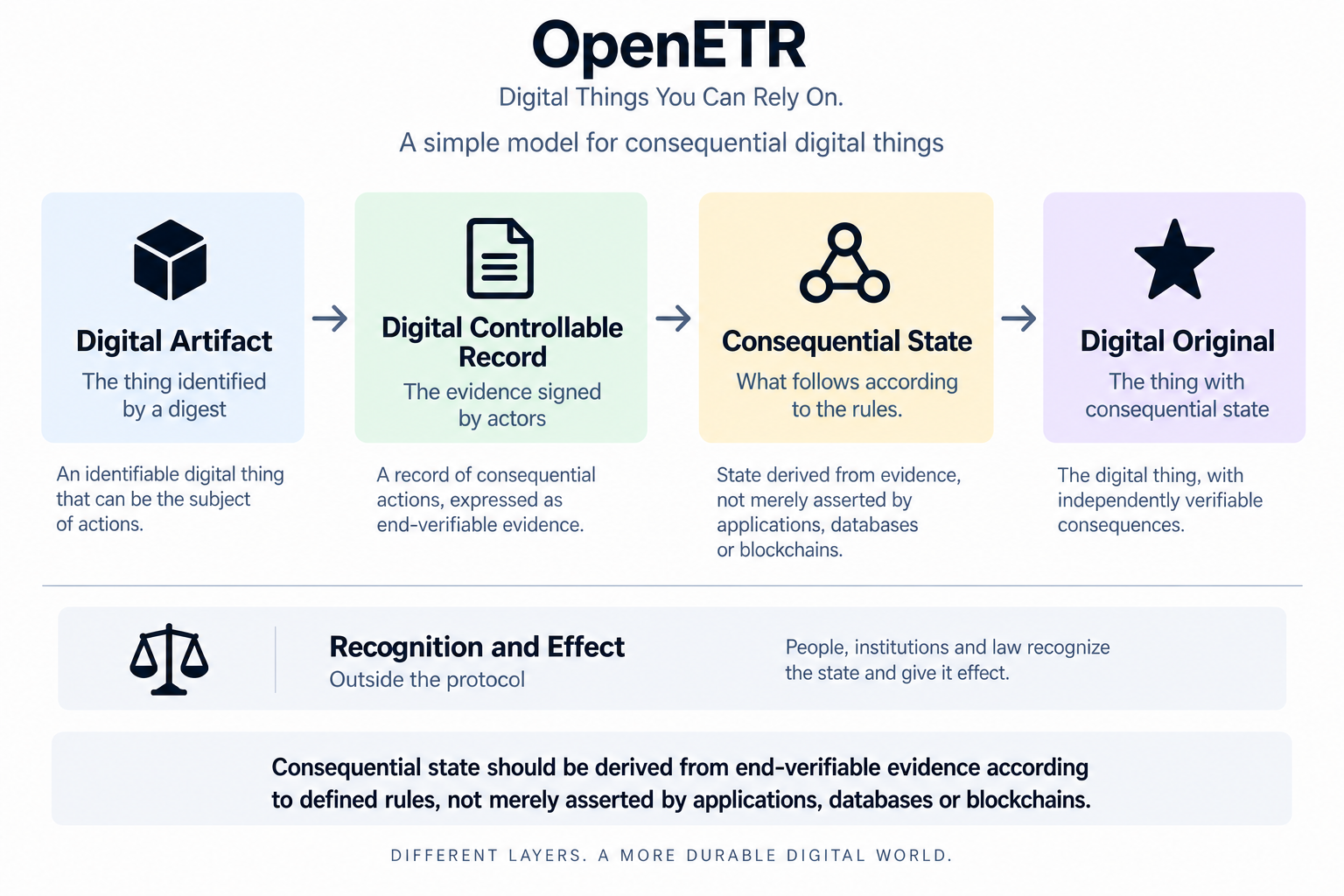
Creation, scanning, translation, rendering, or transformation may produce a new Digital Artifact. Novelty alone does not make it a Digital Original.
Creation produces a Digital Artifact. Consequential state makes that artifact a Digital Original.
Concrete Example: An English Gutenberg Reconstruction
Consider a digitized page from the Gutenberg Bible. The Bible was printed in Latin in Mainz in the mid-fifteenth century, and digitized page images are now available through institutions including the Library of Congress.
Suppose an editor translates the Latin text into English and renders the translation using typography and layout intended to preserve the visual character of the source page. The resulting image is new. Gutenberg never printed this English page. It is neither a scan of an existing physical page nor merely another copy of the source image.
Once finalized, the new content is put into canonical form and assigned a cryptographic digest:
Original Gutenberg page
          |
          | translate and render
          v
   New digital content
          |
          | canonicalize and digest
          v
   DIGITAL ARTIFACT
The digest establishes the content identity of the new artifact. The image may be novel and may be the first representation of its kind, but novelty alone does not make it an OpenETR Digital Original.
Now suppose a scholar, library, archive, publisher, or other institution examines the artifact and signs this statement:
This Digital Artifact is an English reconstruction of the identified Gutenberg Bible page, prepared to represent the content and visual experience of that source page.
The signed end-verifiable record references the artifact's digest. It becomes the first record in a candidate DCR:
DIGITAL ARTIFACT
digest: abc123...
        |
        | referenced by
        v
SIGNED RECORD
        |
        v
DIGITAL CONTROLLABLE RECORD
The DCR may initially contain only that Anchor Event. It may later grow into a graph containing attestations, control transfers, restrictions, superseding versions, or termination records.
The evidence is validated and OpenETR rules derive Consequential State concerning the artifact. A simplified projection might show:
artifact       = abc123...
lifecycle      = active
controller     = <controller key>
anchor signer  = <signing key>
source         = <identified Gutenberg page>
designation    = English reconstruction
evidence       = <basis event ids>
This state is not authoritative merely because an application stored it in a database. Another conforming application can obtain the artifact and DCR, verify the signatures and references, apply the same identified ruleset, and reproduce the applicable Consequential State.
Once Consequential State has been established through the DCR, the artifact is an OpenETR Digital Original in the technical sense:
NEW DIGITAL CONTENT
        |
        v
DIGITAL ARTIFACT
uniquely identifiable content
        |
        v
DIGITAL CONTROLLABLE RECORD
signed end-verifiable evidence spanning the lifecycle
        |
        | validate the evidence
        | apply state transition rules
        v
CONSEQUENTIAL STATE
        |
        v
DIGITAL ORIGINAL
The signature proves which key made the statement, what artifact the statement concerns, and what was said. It does not prove that the signer is a recognized Gutenberg authority. A university might recognize a particular scholar; a national library might recognize its curator; another institution might apply a different recognition policy.
Digital Original
      |
      | signer and state accepted for a purpose?
      v
RECOGNITION
      |
      v
EFFECT
The resulting English image can still be copied freely. Byte-identical copies have the same digest and represent the same Digital Artifact:
Copy A --+
Copy B --+-- same digest --> DIGITAL ARTIFACT abc123...
Copy C --+
Making another copy does not create another DCR, controller, or consequential history. OpenETR does not make the information scarce; it makes the consequential history surrounding its content identity independently verifiable.
The distinction can therefore be summarized precisely:
The translated page is created as a new Digital Artifact. OpenETR rules derive Consequential State from its DCR and make it a Digital Original. Recognition determines whether that state is accepted and what effect it receives for a particular purpose.
The Consequential State Pipeline
Digital originality does not arise from one cryptographic operation or one institutional decision. Canonical content first gives the Digital Artifact a stable identity. One or more signed records concerning that artifact form a candidate DCR spanning its evidenced lifecycle. Those records provide portable evidence of what actors attempted or asserted. The DCR is then evaluated as a whole. Validation checks the evidence; state transition rules determine what Consequential State follows. Consequential State is not another record or container beside the DCR.
Actions have consequences. OpenETR represents consequential actions as end-verifiable events and defines the rules by which those events change consequential state.
Recognition and effect follow from that result. A verifier, institution, community, contract, or jurisdiction decides whether to accept the signer, DCR, and Consequential State for a particular purpose and what practical, institutional, commercial, or legal consequence follows. Keeping these layers separate prevents content identity, cryptographic validity, policy validation, authority, and external effect from being mistaken for one another.
The pipeline therefore separates five questions that are often blended together:
| Layer | Question |
|---|---|
| Artifact | What persistent content is identified? |
| DCR | Which signed record or record graph concerns the artifact? |
| State transition rules and Consequential State | What follows when validated DCR evidence is evaluated according to the rules? |
| Recognition | Who accepts that state, and for what purpose? |
| Effect | What external consequence follows? |
The complete relationship is:
Digital Artifact
  -> Digital Controllable Record
  -> evidence validation and state transition rules
  -> Consequential State and Digital Original
  -> recognition of that state
  -> effect
A candidate Anchor is a one-record DCR concerning a Digital Artifact. A valid Anchor evaluated under OpenETR Core Record Ruleset 1.0 establishes anchored Consequential State and makes the artifact a Digital Original. It does not prove that the signer was uniquely authorized, resolve every competing event, compel a relying party to recognize the result, or create legal effect on its own.
A provenance claim such as “I created this artifact” is different from an authority claim such as “I certify this artifact for purpose X.” OpenETR makes the signer and artifact inspectable. Recognition of the signer's authority is separate.
What OpenETR Contributes
OpenETR derives Consequential State for Digital Artifacts. Signed records can describe anchoring, transfer, encumbrance, discharge, redemption, and termination. Validation determines whether the DCR evidence is acceptable; state transition rules determine what follows in light of prior state.
This lets an independent verifier ask:
- Which Digital Artifact is involved?
- Which events are authentic and structurally valid?
- Which prior state constrains the next transition?
- Who controls the object under the applicable rules?
- Are there unresolved conflicts or active guards?
- Has the lifecycle ended?
The answer can be reconstructed from portable evidence even if the application that first displayed the record is unavailable.
System failure need not become state failure.
Recognition And Effect Remain Contextual
Protocol-valid state is not the same as universally accepted authority. Recognition may come from a law, contract, institution, community, registry, or verifier policy. Effect is the consequence that the recognition context gives the derived state.
The term recognized Digital Original can be used when a Digital Original and its consequential state have been accepted for a stated purpose.
Digital Original + recognition + applicable rules = recognized effect
This distinction keeps the protocol useful without asking it to decide who is a competent issuer, whether a signer is legally authorized, or what every jurisdiction must accept.
A Simple Example
A driver's licence can be scanned to produce digital content whose digest identifies a Digital Artifact. Scanning, hashing, or signing arbitrary content does not by itself create a Digital Original. A relevant authority or controller must create end-verifiable evidence, and OpenETR rules must derive Consequential State from the resulting DCR.
A verifier may then recognize the licensing authority's key and accept that state for a particular purpose. Only at that point does the verification have the corresponding institutional or legal effect.
Physical licence
  -> scan
  -> digital content
  -> stable digest
  -> Digital Artifact
  -> authority or controller creates end-verifiable evidence
  -> Digital Controllable Record
  -> evidence validation and state transition rules
  -> Consequential State
  -> Digital Original
  -> recognition by a competent verifier
  -> accepted effect
The same pattern can apply to warehouse receipts, bills of lading, product passports, permits, certificates, community records, and archives.
Multiple Anchors And Conflicts
A Digital Artifact may have multiple anchors or competing event branches. OpenETR should preserve that evidence rather than silently selecting an authority. Validation can reject invalid transitions, and an identified ruleset can derive candidate Consequential State; recognition determines which result, actor, or policy is accepted in a particular context.
Conflict visibility is therefore a feature, not a defect.
Policy Consequences
Good policy should ask:
- What state variable matters?
- Which events may change it?
- Which signing keys may authorize those events?
- What prior-state constraints apply?
- How can another party derive the same result independently?
- How are conflicts, supersession, and termination handled?
- Who recognizes the result, for what purpose, and with what effect?
This makes the technical boundary explicit while leaving institutional and legal judgment visible.
Bottom Line
OpenETR is not a magic originality machine and does not try to prevent copying. It gives copied digital content a portable, verifiable history from which consequential state can be independently derived.
A copy can reproduce content. It cannot independently reproduce consequential state.
The architectural objective is simple:
Digital Originals should outlive applications.