Beyond The Barcode
Independent verification for regulators and enforcement officers. October 14, 2026.
Policy Proposition
A barcode can identify a product at checkout or take a consumer to a website experience. With product identifiers and a document digest, that same barcode can also give an enforcement officer the information needed to retrieve and verify supporting evidence independently, without trusting the linked website or requiring it to be available. An independent repository or retained copy can supply the evidence instead. These are different capabilities, even when they begin with the same scan.
Opening a product page answers what does this source say? Independent verification asks does this exact record match the reference, who signed the evidence, does it cover this product, and is it acceptable for this purpose?
OpenETR supports that separation. A digest identifies exact artifact bytes; signed events provide attributable evidence about those bytes. The responsible authority applies its own recognition and acceptance rules. A website, relay, repository, or retained file can supply evidence without becoming its exclusive integrity authority.
The website delivers information. Your checks establish what you can rely on.
The Verification Workflow
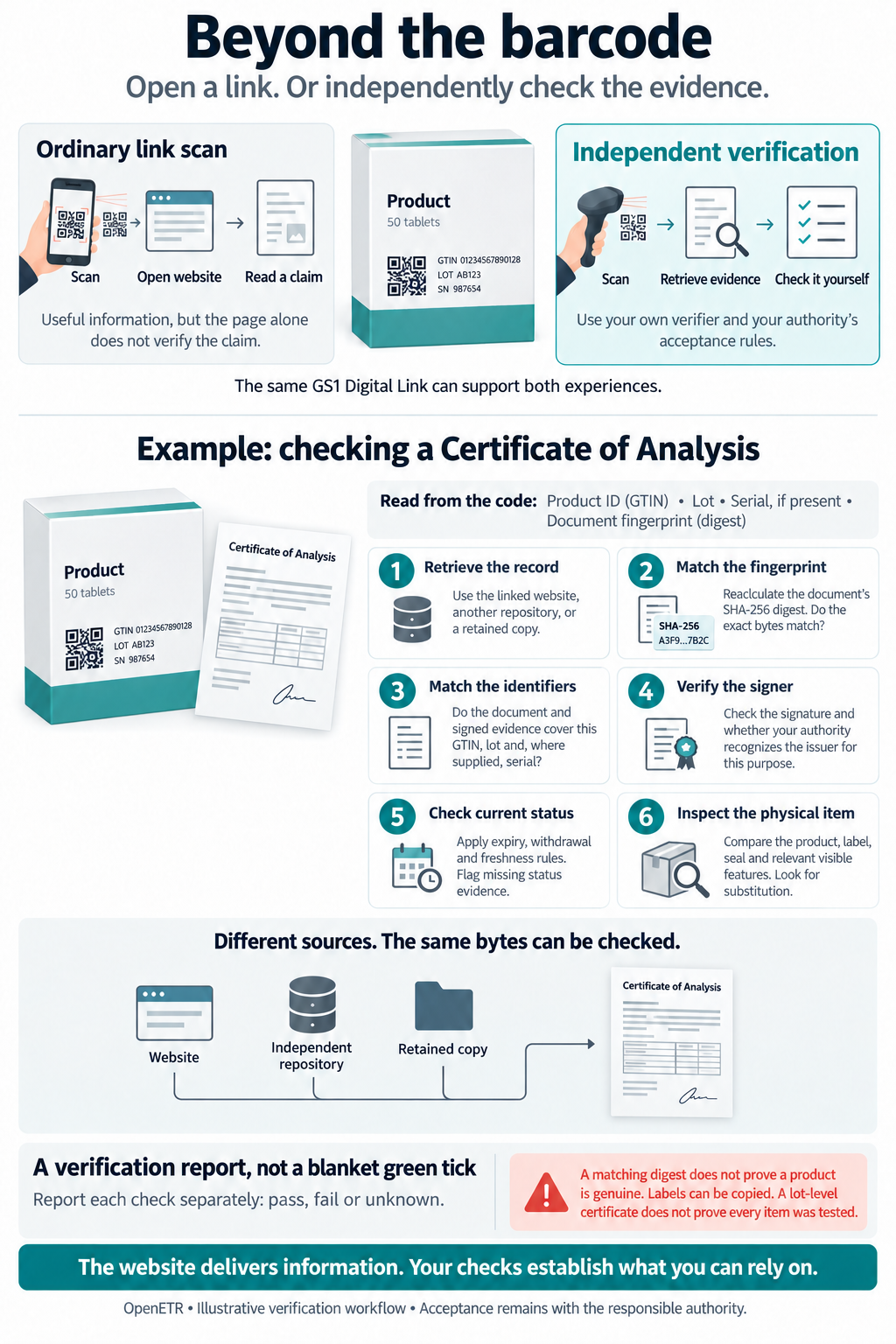
Select the infographic to open the full-size image. Product identifiers and barcodes are illustrative, not production labels. This is a conceptual workflow, not a claim that every check is implemented or that an assurance level has been certified.
The smartphone and dedicated scanner illustrate different experiences, not a hardware requirement. An authority's smartphone application could perform the independent workflow too. The difference is the software's checks and the authority's rulebook, not the device used to acquire the code.
One Scan And Different Questions
A GS1 Digital Link can carry a product identifier (GTIN), lot, and optional serial number. OpenETR's digest extension adds a reference to exact digital material. A consumer can open the HTTPS link with a compatible phone camera; an authority's verifier can extract the fields without automatically visiting the printed domain.
That verifier may obtain the same material from an independent repository or a retained copy. It does not have to accept the website's presentation as proof. Alternate retrieval still requires an available copy and a way to discover it: a digest is neither storage nor an availability guarantee.
The barcode is a starting reference, not a trust anchor by itself. An attacker could replace a label with a different digest and a different issuer's record. Issuer recognition and inspection remain essential even when every byte matches.
A Certificate Of Analysis Example
Consider a packaged product bearing a GTIN, lot number, and a digest referring to a Certificate of Analysis. An officer's application should support distinct checks rather than collapse everything into one green tick.
- Retrieve the record. Obtain the certificate and related signed evidence from an available source. The printed website is one option, not the only one.
- Match the fingerprint. Recompute SHA-256 over the certificate's exact bytes and compare it with the scanned digest. A visually similar document is not necessarily the same file.
- Match the identifiers and scope. Check that the authenticated evidence covers the scanned GTIN and lot, and the serial if supplied. When the certificate itself is meant to contain those identifiers, check them inside the verified document as well. A lot-level certificate does not establish that each package was individually tested.
- Verify the signer and recognize the issuer. Validate the signature and its binding to the digest and relevant identifiers. Separately determine whether the authority recognizes that key for this issuer and purpose. A key found in the scanned material is not automatically a trusted key.
- Check current acceptability. Apply the relevant expiry, withdrawal, supersession, key-status, and freshness requirements. An original file can still match its digest after it ceases to be acceptable. Unavailable status evidence must be reported, not silently treated as confirmation.
- Inspect the physical item. Compare the product, label, seal, and relevant visible features with the record. Look for substitution, overlays, or evidence of removal. Photographs can assist comparison but are not proof of provenance.
The report should identify each outcome as pass, fail, or unknown, retain the evidence and relevant observation times, and identify the rules used. The authority decides what those results mean for the inspection.
What Verification Does Not Establish
| Check | What it supports | What remains separate |
|---|---|---|
| Matching digest | The retrieved bytes match the scanned commitment. | Truth, authorship, current status, and physical authenticity. |
| Valid signature | The signed payload verifies under a particular key. | Recognition of the issuer, key compromise, and accuracy of claims. |
| Matching identifiers | The evidence covers the specified product class, lot, or instance. | Whether this label belongs on this physical item. |
| Recognized issuer | The authority accepts the key for a specified role and purpose. | Authority for other purposes or automatic acceptance of every claim. |
| Physical inspection | Observed features support the item's association with the label and record. | Guaranteed detection of copying, substitution, or tampering. |
Physical Integrity And Product Association
Digital verification checks the record. Physical inspection asks a different question: does this barcode belong with the product being presented? A copied or substituted barcode can point to genuine, correctly signed evidence about another product. The physical construction and placement of the code therefore form part of the inspection design, not an incidental printing choice.
The appropriate protection depends on the purpose, handling environment, and consequences of substitution. Not every use requires a security label.
Printed On Packaging
A barcode printed directly on ordinary packaging may suffice when the purpose is to retrieve product information or check a lot-level document and the authority's procedure accepts that level of physical association. An officer can compare the printed product identifiers, packaging, and visible features with the verified record.
Direct printing avoids a separately attached label, but does not prevent copying the package, overlaying the code, or replacing its contents. It supports an association with the packaging; it does not independently establish the authenticity of what is inside.
Privately Revealed Barcodes
A code can be concealed beneath a scratch-off layer, inside a sealed package, or behind another controlled-reveal feature. An authorized inspector or intended recipient can expose it when needed. The condition of the covering or seal can provide evidence of earlier access, depending on its design and inspection.
Concealment limits casual access before disclosure; it does not make the code uncopyable or prove that nobody has seen it. Once revealed, it can be photographed and reproduced. A private reveal is also not access control for the referenced record: sensitive material still needs an explicit authorization and disclosure design. The procedure should specify who may reveal the code and how opening or damage is recorded.
Secure Substrates And Tamper Evident Attachment
Where substitution poses a greater risk, the barcode can be printed on a secure substrate and physically bound to the product or its enclosure. Possible designs include destructible labels, attachments that leave visible evidence of removal, or seals spanning an opening. Inspectable security features may help an officer distinguish the intended material from an ordinary reproduction.
The substrate, attachment, and placement must work together. A secure label that can be moved intact provides weak evidence of product association. A seal on an outer carton may bind the code to that carton without binding it to every item inside. The record and inspection instructions should state the intended scope: product, package, lot, or individually identified unit.
These designs require testing against removal, reapplication, overlays, copying, package opening, and normal wear. "Tamper-evident" means that specified forms of interference can leave observable evidence under defined conditions, not that tampering is impossible or always detectable. Photographs and recorded physical features can assist inspection without replacing that testing.
The digest binds the reference to exact digital material. Physical design and inspection support the association between that reference and the actual item. Neither substitutes for the other. OpenETR does not prescribe a universal label construction or certify physical security; the domain's rulebook determines the required protection and how an officer handles a damaged, exposed, mismatched, or uncertain label.
Open Evidence And Explicit Authority
The proposed architecture permits independent issuers, repositories, and verification applications. Open participation does not mean every issuer is credible or every signed assertion is acceptable.
OpenETR supplies evidence that can be evaluated outside the originating application. Domain rulebooks supply the meanings, required checks, recognized issuers, and decision criteria. They also determine how to handle incomplete, conflicting, or stale evidence. Semantic interoperability remains a domain responsibility; a digest does not define what a laboratory result means.
In the current OpenETR convention, the artifact digest and the signed Nostr event identifier are distinct. The barcode's digest extension identifies the artifact bytes; an anchor event can bind that digest to signed product tags. Such tags do not by themselves establish that the same identifiers appear inside the artifact. Each verifier must check the association its use case requires.
Conditions For Deployment
Authorities should specify the exact hashed object and signed payload, supported formats, identifier scope, issuer recognition arrangements, and status requirements before relying on a deployment. The workflow is not a substitute for these choices.
A practical pilot should verify the same record with two independent clients, including retrieval from an alternate source. Tests should include an edited file, mismatched lot, unrecognized signer, withdrawn record, unavailable evidence, and a copied label. Results should show which checks fail or remain unknown, not just whether a page loaded successfully.
Preservation and access arrangements matter too. A digest is not encryption; public references can enable correlation, and predictable records may be guessed. Sensitive identity or health records require a separate access and disclosure design. The same separation of retrieval, verification, recognition, and physical or holder checks can support other domains without making public disclosure mandatory.
The policy opportunity is not to replace inspection with a scan. It is to give inspectors portable evidence they can check with tools and rules they control.
Background And Further Reading
- Verifiable Barcodes: An Independently Verifiable Architecture: background concept note, October 14, 2026; access may require permission.
- GS1 Digital Link and verifiable product information: multiple scanning experiences and trust models.
- Product information design note: identifiers, content addressing, and signed associations.
- Barcode acquisition and anchor discovery: discovery when a scanned code supplies identifiers rather than a digest.
- QR production and scratch-off considerations: physical label and scanning considerations.
- OpenETR wire format: artifact digests, signed events, and structured tags.